On this page
- Minecraft Villager Jobs
- How Minecraft Villager Jobs Work
- 1. Armorer
- Why the armorer is useful
- Best reason to use one
- Limitations
- 2. Butcher
- Why the butcher is useful
- Best reason to use one
- Limitations
- 3. Cartographer
- Why the cartographer is useful
- Best reason to use one
- Limitations
- 4. Cleric
- Why the cleric is useful
- Best reason to use one
- Limitations
- 5. Farmer
- Why the farmer is useful
- Best reason to use one
- Limitations
- 6. Fisherman
- Why the fisherman is useful
- Best reason to use one
- Limitations
- 7. Fletcher
- Why the fletcher is useful
- Best reason to use one
- Limitations
- 8. Leatherworker
- Why the leatherworker is useful
- Best reason to use one
- Limitations
- 9. Librarian
- Why the librarian is useful
- Best reason to use one
- Limitations
- 10. Mason
- Why the mason is useful
- Best reason to use one
- Limitations
- 11. Shepherd
- Why the shepherd is useful
- Best reason to use one
- Limitations
- 12. Toolsmith
- Why the toolsmith is useful
- Best reason to use one
- Limitations
- 13. Weaponsmith
- Why the weaponsmith is useful
- Best reason to use one
- Limitations
- 14. Unemployed Villager
- Why unemployed villagers matter
- Best reason to keep one around
- 15. Nitwit
- Why nitwits are different
- Best reason to know about nitwits
- Best Minecraft Villager Jobs to Prioritize
- Tips for Managing Villager Jobs Efficiently
- Final Thoughts
Minecraft villages look simple on the surface, but villagers are one of the most useful systems in the entire game. The right villager can turn a basic settlement into a renewable source of enchanted books, diamond gear, food, arrows, building blocks, and even rare maps.
If you have ever looked at a villager and wondered what their job actually does, this guide breaks down every Minecraft village job in a practical way. You will see which workstation creates each profession, what that villager is best for, and which jobs are worth prioritising early, mid, and late game.
Minecraft Villager Jobs
Tap any job in the table to jump to its details below.
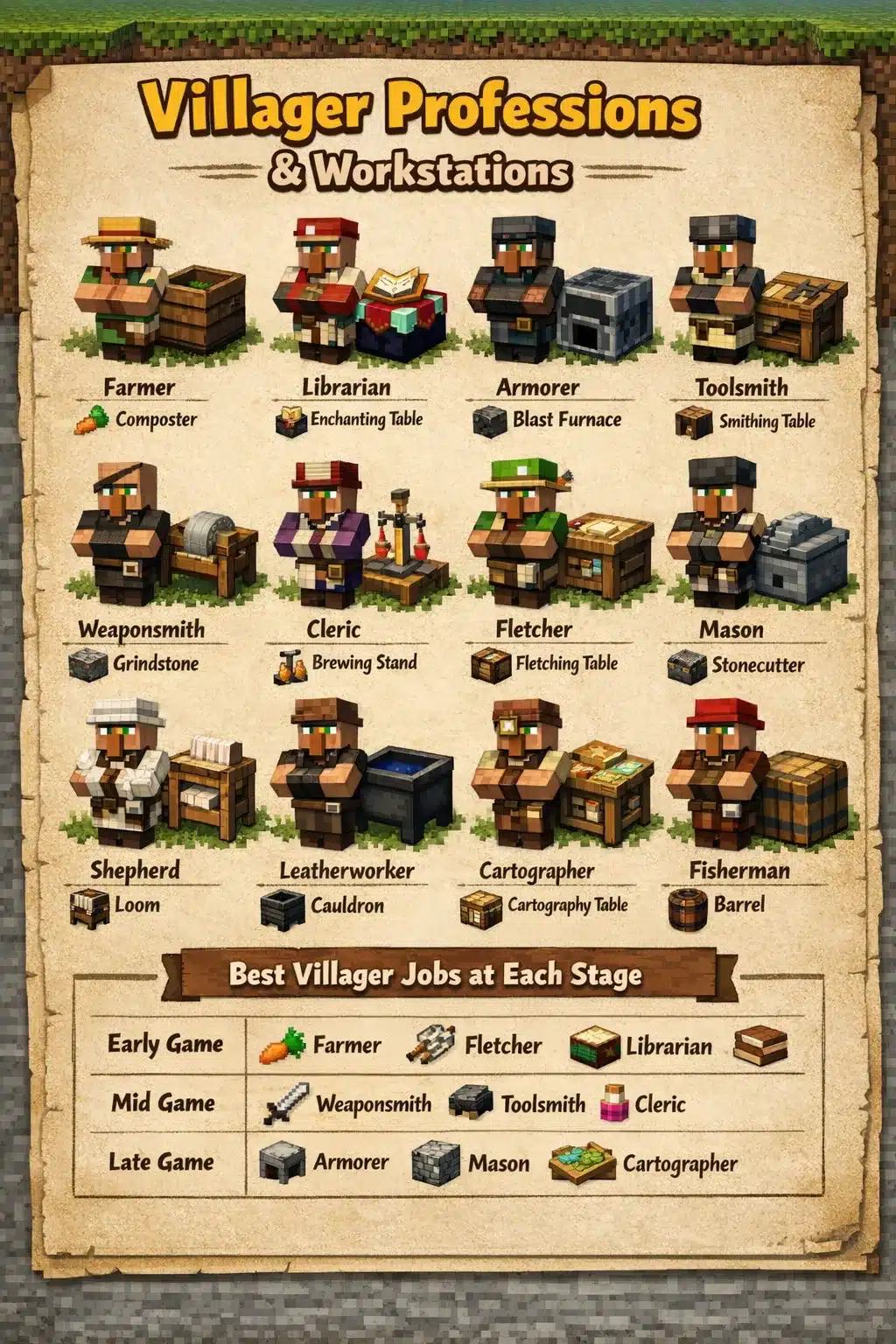
| Villager job | Workstation block | Best use | Common high-value trades | Quick verdict |
|---|---|---|---|---|
| Armorer | Blast Furnace | Armor progression | Iron armor, chainmail, diamond armor | Excellent for gear-heavy survival worlds |
| Butcher | Smoker | Food trading | Cooked meats, emeralds for raw food | Useful, but not usually a top priority |
| Cartographer | Cartography Table | Exploration | Ocean explorer maps, woodland explorer maps, banners | Great for map hunters and adventurers |
| Cleric | Brewing Stand | Rare materials | Redstone, lapis lazuli, glowstone, ender pearls | One of the most valuable utility villagers |
| Farmer | Composter | Early emerald farming | Bread, apples, pumpkin pie, golden carrots, crop buybacks | Best starter villager for steady emerald income |
| Fisherman | Barrel | Fishing-related supplies | Fish trades, campfire, fishing rod items | Situational but decent near water bases |
| Fletcher | Fletching Table | Cheap emerald generation | Usually, the most important villager job | One of the easiest money-makers in the game |
| Leatherworker | Cauldron | Saddle access and leather gear | Leather armor, saddles, horse armor | Niche, but saddles can be worth it |
| Librarian | Lectern | Enchanting and utility | Flexible and useful for job assignments | Enchanted books, name tags, lanterns, and glass |
| Mason | Stonecutter | Building block economy | Bricks, stone variants, terracotta, quartz blocks | Excellent for builders |
| Shepherd | Loom | Wool and decoration | Colored wool, dyes, paintings, beds | Helpful for decorative or wool-focused builds |
| Toolsmith | Smithing Table | Tool upgrades | Iron tools, diamond tools | Strong choice for long survival runs |
| Weaponsmith | Grindstone | Weapon upgrades | Iron weapons, enchanted weapons, diamond weapons | Good for combat-focused play |
| Unemployed Villager | None | Can become a profession | No trades yet | Flexible and useful for job assignment |
| Nitwit | None | No real function | No trades | Cannot take a normal job |
How Minecraft Villager Jobs Work
Villager jobs are tied to workstation blocks. When an unemployed villager can reach an unclaimed workstation during work hours, they may take on that profession. For example, place a lectern near an unemployed villager and they can become a librarian.
There are two important rules to remember:
- A villager without any completed trades can change professions if you remove their workstation and assign a new one.
- Once you trade with that villager at least once, the profession and trade pool become locked.
That is why players often reroll librarians, fletchers, and armor-related villagers until they get the exact trade they want before making the first deal.
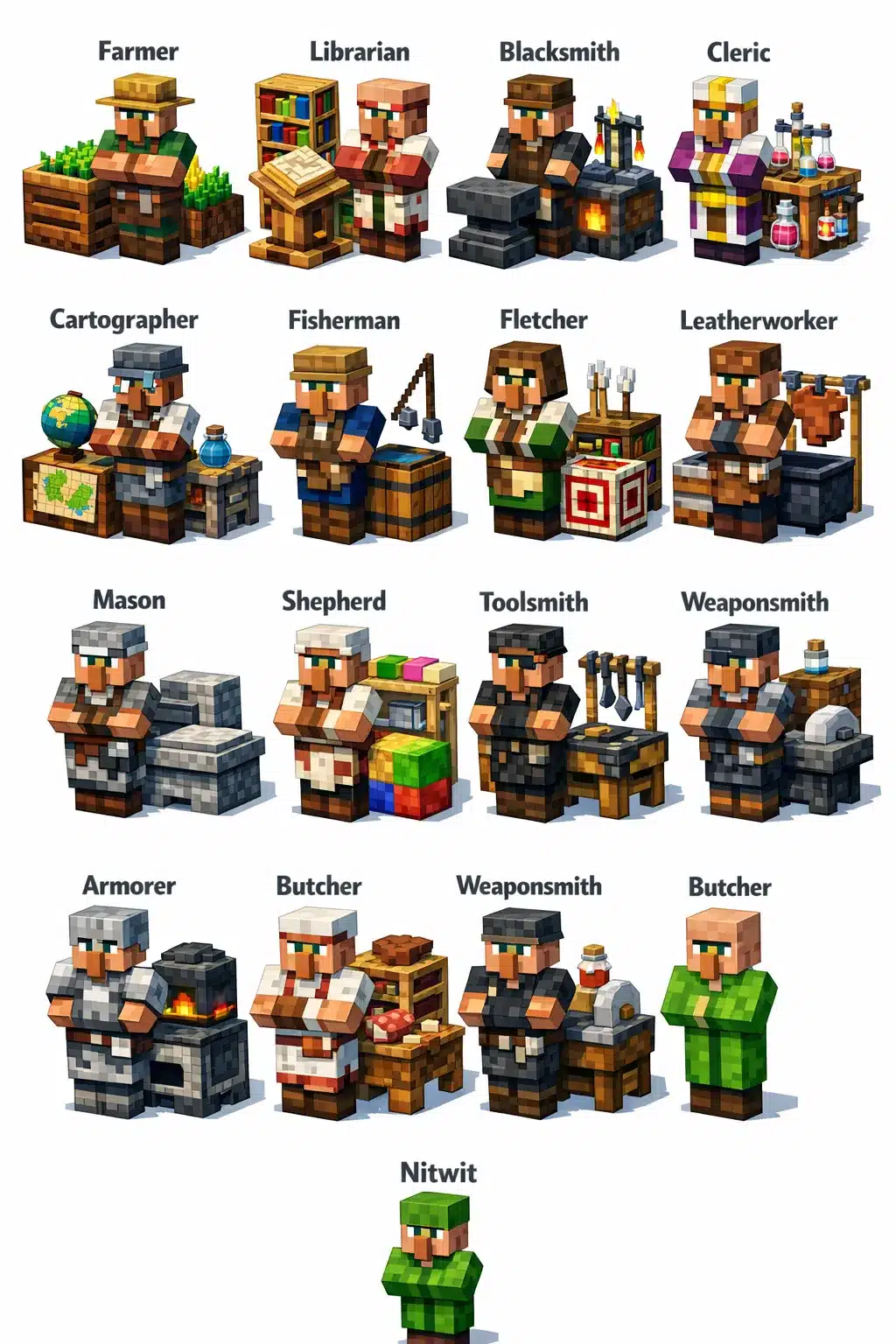
1. Armorer
Workstation: Blast Furnace
The armorer is all about defensive gear. This villager starts with lower-tier armor trades and can eventually offer strong armor upgrades, including diamond armor at high levels.
Why the armorer is useful
- Helps you skip some mining and crafting pressure
- Gives a renewable path to armor pieces
- Becomes especially valuable on servers or hardcore worlds where replacing lost gear matters
Best reason to use one
An armorer can save time when you want reliable armor progression without depending entirely on ore luck. If your village trading hall is focused on survival efficiency, this profession is a strong pick.
Limitations
Armor pieces may not always have the exact enchantments you want, so armorers work best alongside librarians rather than as a replacement for them.
2. Butcher
Workstation: Smoker
The butcher specializes in meat-related trades. They often buy animal products and sell cooked food items.
Why the butcher is useful
- Offers a simple food-focused trade path
- Fits naturally into animal farm setups
- Can turn livestock production into emeralds
Best reason to use one
If your base already has cow, pig, or chicken farms, the butcher gives you a clean way to convert excess resources into trading value.
Limitations
Compared with librarians, fletchers, farmers, or clerics, butchers usually rank lower in priority. They are convenient, but rarely game-changing.
3. Cartographer
Workstation: Cartography Table
The cartographer is the villager for explorers. This profession is best known for selling maps that point to special structures.
Why the cartographer is useful
- Sells explorer maps for ocean monuments and woodland mansions
- Supports long-distance exploration goals
- Fits well with players collecting banners, maps, or base markers
Best reason to use one
A cartographer is worth adding when you want structure-hunting help without relying on random exploration. This becomes especially useful in large survival worlds where you want efficient travel targets.
Limitations
If your main goal is combat gear, enchantments, or fast emeralds, the cartographer is more of a specialty villager than a core one.
4. Cleric
Workstation: Brewing Stand
The cleric is one of the most underrated villagers in Minecraft. This profession gives access to several useful materials that are normally annoying to gather in bulk.
Why the cleric is useful
- Buys rotten flesh, which turns mob farming leftovers into emeralds
- Sells redstone dust and lapis lazuli
- Can provide glowstone and ender pearls at higher levels
Best reason to use one
A cleric is fantastic for players building redstone systems, enchanting gear, or preparing for End progression. Being able to buy ender pearls alone can save a lot of time.
Limitations
The cleric is more of a utility villager than a front-line progression villager, so they shine most when your world is already moving beyond the basic survival phase.
5. Farmer
Workstation: Composter
The farmer is the most beginner-friendly villager job in the game. Farmers buy common crops and sell practical food items, making them the easiest route to early emerald income.
Why the farmer is useful
- Buys wheat, carrots, potatoes, pumpkins, and melons
- Works beautifully with crop farms
- Sells food items that are useful in day-to-day survival
Best reason to use one
If you want an early-game emerald engine, start with farmers. A simple crop farm can feed multiple farmer trades and generate emeralds consistently with very low risk.
Limitations
Farmers are amazing for economy building, but they are not your main source of high-end gear. They are usually the foundation that helps fund better villagers later.
6. Fisherman
Workstation: Barrel
The fisherman focuses on fish-based trading and a few fishing-related supplies. This villager is solid, especially if your base is near an ocean, river, or fishing dock.
Why the fisherman is useful
- Buys fish for emeralds
- Fits naturally into fishing or waterfront builds
- Can provide a few practical survival items
Best reason to use one
A fisherman is a nice support villager when you already collect a lot of fish, either manually or through fishing-related gameplay loops.
Limitations
This is usually a convenience profession rather than a must-have one. Most players will prioritize farmer, fletcher, librarian, and cleric first.
7. Fletcher
Workstation: Fletching Table
The fletcher is one of the best villager jobs in Minecraft because it turns a very cheap resource into emeralds. Many players build an entire trading setup around this profession.
Why the fletcher is useful
- Buys sticks for emeralds
- Sells arrows, bows, and crossbows
- Pairs perfectly with tree farms
Best reason to use one
The sticks-for-emeralds trade is the star here. Wood is easy to farm, so fletchers create one of the most reliable and scalable emerald loops in the game.
Limitations
If you do not want to manage wood farming, the fletcher loses some of its appeal. Even then, it is still a very efficient profession in most survival worlds.
8. Leatherworker
Workstation: Cauldron
The leatherworker is a niche profession, but not a useless one. The biggest draw is access to a few horse-related or exploration-friendly items.
Why the leatherworker is useful
- Sells leather gear
- Can offer saddles
- Supports horse travel and early mobility setups
Best reason to use one
If you need a renewable source of saddles without depending on loot chests, the leatherworker can be genuinely helpful.
Limitations
Outside of saddle access and some specialty gear, this is not one of the strongest professions. Most players add a leatherworker only after their core trading hall is already complete.
9. Librarian
Workstation: Lectern
The librarian is widely considered the best villager job in Minecraft. If you only build one profession on purpose, make it a librarian.
Why the librarian is useful
- Sells enchanted books
- Can offer high-value enchantments like Mending, Unbreaking, Efficiency, Protection, and Fortune
- Provides utility trades such as name tags
Best reason to use one
Librarians let you target specific enchantments rather than relying on random enchanting table luck. That single advantage changes the entire progression curve of a survival world.
Limitations
The real cost is time. Players often break and replace lecterns repeatedly until the first book trade rolls the enchantment they want. It can take patience, but the payoff is absolutely worth it.
10. Mason
Workstation: Stonecutter
The mason is an excellent villager for builders. This profession buys stone-related materials and can sell decorative blocks that are useful for high-quality builds.
Why the mason is useful
- Buys clay, stone, or related materials depending on trade tiers
- Sells bricks, terracotta, quartz blocks, and polished stone variants
- Supports large-scale building projects
Best reason to use one
If your Minecraft world is heavily focused on architecture, the mason can save a huge amount of gathering and smelting time.
Limitations
For players who care mostly about combat or enchantments, the mason will feel optional. For builders, though, this profession can become one of the best in the village.
11. Shepherd
Workstation: Loom
The shepherd is the decorative specialist of the villager system. This profession works best when you enjoy base styling, banners, colors, and wool-heavy designs.
Why the shepherd is useful
- Buys wool for emeralds
- Sells colored decorative materials
- Helps with banners, beds, paintings, and general build variety
Best reason to use one
A shepherd becomes very useful once you have a sheep farm. Wool turns into emeralds, and the profession also supports more creative building projects.
Limitations
Like the mason, this villager is more valuable to builders than to pure progression players.
12. Toolsmith
Workstation: Smithing Table
The toolsmith helps you secure reliable tools without crafting every upgrade yourself. At higher levels, this villager can become a strong source of premium tools.
Why the toolsmith is useful
- Provides tool progression through trading
- Can eventually offer diamond tools
- Reduces pressure on ore gathering
Best reason to use one
A toolsmith is great in long survival worlds where you want renewable, trade-based gear systems. Combined with librarians, you can buy tools and then enchant them exactly the way you want.
Limitations
If you already have strong mining infrastructure, the toolsmith is more of a convenience upgrade than a necessity.
13. Weaponsmith
Workstation: Grindstone
The weaponsmith is the combat-focused version of the toolsmith. This villager helps players who want steady weapon progression through trading.
Why the weaponsmith is useful
- Sells weapons at multiple quality tiers
- Can offer strong late-game weapon options
- Supports players who want backup gear for raids, caving, or PvP-style preparation
Best reason to use one
If your world has a lot of danger, or you simply want a trading hall that can replace lost combat gear quickly, the weaponsmith is a strong addition.
Limitations
Like the armorer and toolsmith, the weaponsmith becomes much better when paired with librarians for proper enchantment control.
14. Unemployed Villager
Workstation: None
An unemployed villager is not a profession yet, but it is still one of the most useful villager states in the game.
Why unemployed villagers matter
- They can still be assigned to most professions
- They give you flexibility when building a trading hall
- They are the starting point for rerolling into the exact job you need
Best reason to keep one around
If you are designing an optimized village, unemployed villagers are basically blank templates. You decide what they become by placing the workstation you want.
15. Nitwit
Workstation: None
The nitwit is the one villager type that does not contribute to trading progression.
Why nitwits are different
- They wear a distinct green outfit
- They do not take normal villager jobs
- They do not offer standard profession trades
Best reason to know about nitwits
Mainly so you do not waste time trying to assign them a workstation. If a villager refuses to take a job and wears green, you are dealing with a nitwit.
Best Minecraft Villager Jobs to Prioritize
If you are building a practical village or trading hall, these are usually the best jobs to get first:
- Librarian for enchanted books and name tags
- Farmer for easy early emerald income
- Fletcher for sticks-to-emeralds trading
- Cleric for redstone, lapis, glowstone, and ender pearls
- Armorer, Toolsmith, and Weaponsmith for renewable gear progression
After that, the best choices depend on your playstyle:
- Choose Mason and Shepherd if you love building
- Choose Cartographer if you enjoy exploration
- Choose Leatherworker if saddle access matters
- Choose Butcher or Fisherman if your farms naturally support those trades
Tips for Managing Villager Jobs Efficiently
To get better results from your village, keep these practical tips in mind:
- Place only the workstation you want nearby when assigning a new profession
- Trade once only after you confirm the villager has the right profession and trade setup
- Protect villagers with lighting, walls, and beds so zombies or raids do not wipe out your progress
- Use rail systems, boats, or minecarts to move villagers into a controlled trading hall
- Pair gear villagers with librarians so your bought equipment can be enchanted properly
Final Thoughts
Minecraft village jobs are much more than cosmetic roles. They create a full progression system that can replace random loot grinding with renewable, controllable trading.
If you want the strongest all-around village, start with librarians, farmers, fletchers, and clerics. Those four professions cover enchantments, emerald income, utility resources, and day-to-day survival support. From there, add armor, weapon, tool, builder, or exploration villagers based on how you actually play.
The best part is flexibility. Once you understand workstations and profession locking, you can shape an ordinary village into a custom economy built exactly for your world.

Sumit
ContributorHi, I'm Sumit, Being an introvert I have always been obsessed with technology-computers and reading dozens of posts to learn, find answers out of my curiosity. I love to write as I explore more.