Parallel downloading splits one large file into several chunks and pulls them at the same time. Chromium browsers expose it as an experimental flag. It can speed up big downloads when the server allows multiple connections, but it is not a magic fix for every slow link.
Also see best privacy browsers, Chrome extensions worth installing, and downloading YouTube videos legally for related speed and browser tips.
What parallel downloading does
A normal browser download uses one connection from start to finish. With parallel downloading enabled, Chromium can request several byte ranges at once, then merge them into the finished file. You need a server that supports range requests and enough bandwidth on your side to use the extra streams.
Enable parallel downloading by browser
1. Google Chrome
Desktop + Android
Quick link: chrome://flags/#enable-parallel-downloading
- Paste the URL above into the address bar and press Enter.
- Set Parallel downloading to Enabled.
- Click Relaunch.
On Android, open the same flags URL in Chrome, enable the flag, and tap Relaunch. iOS Chrome does not expose flags.
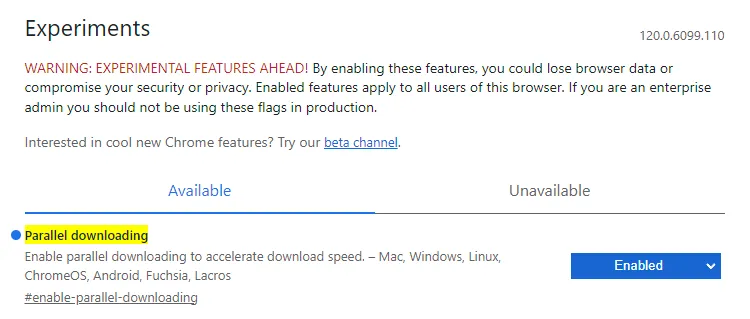
To turn it off, return to the flag, choose Disabled, and relaunch.
2. Microsoft Edge
Desktop + Android
Edge uses the same Chromium flag system.
- Open
edge://flags/#enable-parallel-downloading. - Set Parallel downloading to Enabled.
- Click Relaunch.
Android Edge follows the same steps inside edge://flags. Managed work or school profiles may hide experimental flags.
3. Brave
Desktop + Android
- Open
brave://flags/#enable-parallel-downloading. - Enable Parallel downloading.
- Relaunch Brave.

Brave on Android uses brave://flags the same way. Disable the flag and relaunch if a host misbehaves with range requests.
4. Mozilla Firefox
No built-in flag
Firefox does not ship a Parallel downloading toggle like Chromium browsers. Changing network.http.max-persistent-connections-per-server in about:config controls how many tabs share connections; it is not the same as splitting one file into parallel parts.
For multi-connection downloads in Firefox, use a download manager such as Free Download Manager or aria2. Both add segmented downloads outside the browser.

Pros and cons
Pros
- Can shorten large file downloads when the host allows multiple ranges.
- Built into Chromium with no extra install once the flag is on.
- Falls back to a single stream when a server does not support splitting.
Cons
- Experimental: Google can rename, remove, or enable it by default in future releases.
- Some servers cap connections per IP, which limits the benefit.
- Uses more bandwidth at once, which can affect other devices on the same network.
- Small files may not speed up and can add overhead.
If the flag is missing
Update the browser first (Settings > About on desktop, Play Store on Android). Chrome updates sometimes reset flags to Default, so re-enable and relaunch after a version bump. On enterprise-managed PCs, IT policy may hide chrome://flags entirely.
Does parallel downloading always work?
Is parallel downloading enabled by default in Chrome?
Does parallel downloading use more data?
Can I use parallel downloading in Firefox?
Will parallel downloading slow down my PC?
Is the parallel downloading flag safe?

I write as a writer, as someone very familiar with the Internet, as someone who is completely at ease with current technology and the way it is transforming the social fabric of the globe, the business world in particular.